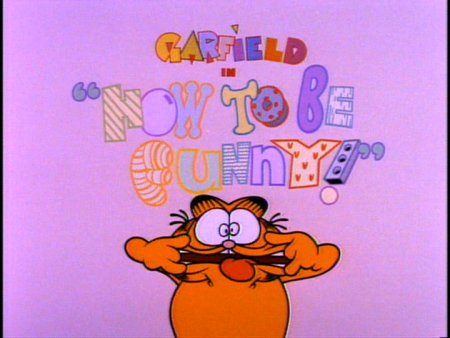
In the Garfield and Friends Season 2 episode "How To Be Funny," Garfield discusses several cheats to humor that can be deployed for those who lack the knack. "If at first something's not funny," he suggests, "just keep doing it and eventually it becomes a running gag."
Garfield and Friends had already employed this strategy with "The Klopman Diamond," something writer Mark Evanier would work into multiple scripts a season just for the sake of it. By itself, a diamond isn't funny, but if it just keeps showing up and getting mentioned for no reason, somehow it is.
There are jokes that get repeated because they're funny in and of themselves. But then there are things that get repeated simply to get repeated. This is a form of the classic running gag that has become the most common method of joke-telling on the Internet: the MEME. I think we can define a meme as something that has no logical reason to be popular other than the fact that everybody repeats it. A joke requires a certain structure, and the right cocktail of shock, timing and surprise. But a meme can be anything. It can be a phrase. It can be a photograph. It can be an 8-bit cat that is also a Pop Tart flying through space leaving a rainbow trail. It can be a set of numbers.
You don't need talent or comic timing to come up with a meme or share one, which is why they are so common today. While the Internet has amplified the popularity and frequency of memes, they did not originate there. Here are five illogical phenomena from past decades that definitely fall under the definition of memes, even if there was no social media to spread them around in.
ONE OF OUR ________ IS MISSING
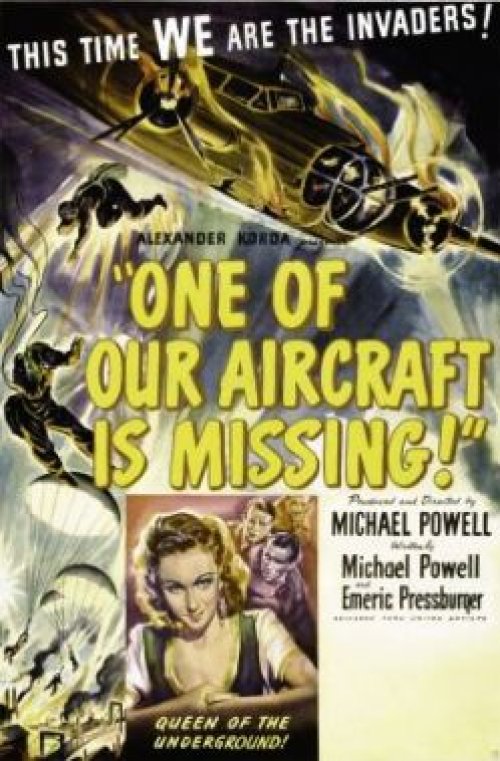
In 1942, a war film was produced and released in Britain called One Of Our Aircraft Is Missing. It's about six members of the Royal Air Force who are forced to bail out of their bomber after one of its engines becomes damaged. Now in the Netherlands, the five members of the RAF try to track down their sixth missing member, only to curiously hear from the Dutch that there has been no report of a crashed airplane.
The title was a reference to an oft-repeated bit of news during radio reports at the time: "One of our aircraft failed to return." This was the working title, in fact, but was changed to be slightly less dour. Technically produced as propaganda to improve morale in England during World War II, One Of Our Aircraft Is Missing became popular in its own right, and not just in its home country.
By the 1960s One Of Our Aircraft Is Missing was well known enough in America that locally produced movies and TV shows started referencing its title...but in odd ways. Somehow, it became an ongoing joke to title an episode of a TV series after this movie, and everybody in Hollywood started doing it. Name a classic series from the 60s or 70s, and chances are, at least one of its episodes will have a "One Of Our _____ Is Missing" title.
There's a Lost In Space episode called "One Of Our Dogs Is Missing." There's an episode of I Dream Of Jeannie called "One Of Our Bottles Is Missing." There's an animated Star Trek episode called "One Of Our Planets Is Missing." There's a Welcome Back Kotter episode called "One Of Our Sweathogs Is Missing." Remember our article on Jennifer Slept Here, and the episode about Jennifer getting trapped in a jar? It was called "One Of Our Jars Is Missing." At no point in the episode does the jar go missing.
This practice stopped somewhere around the mid-80s, when I guess the joke just wore itself out, and it occurs less frequently from there, disappearing altogether by the 1990s.
I SAY IT'S SPINACH
If I told you E.B. White, the author of Charlotte's Web, started a meme, you'd ask "Which book of his did it come from?" And the answer is...none of them. White's meme originated from, of all things, a New Yorker cartoon that he wrote the caption on.
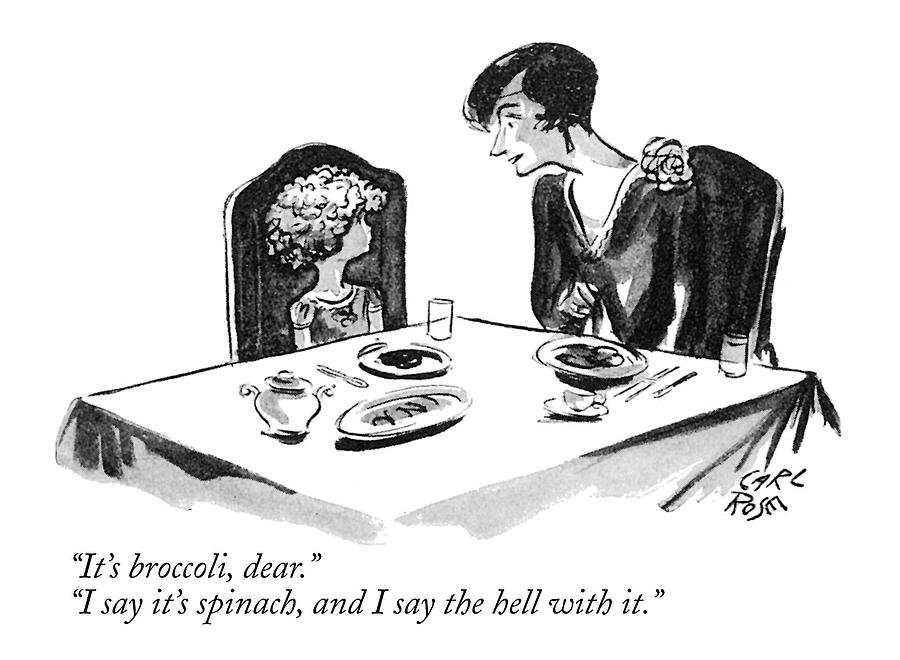
In the December 8, 1928 issue of The New Yorker, a cartoon appears depicting a mother and daughter sitting down to dinner. The mother urges her kid to eat her vegetables. "It's broccoli, dear," she tells her. The girl snottily replies, "I say it's spinach, and I say the hell with it." The drawing was by Carl Rose, the words were by White.
It might help to know broccoli was...."new." Italian immigrants had recently brought the plant to the East Coast of the US, and American citizens were just then getting used to its existence. The sentiment of the cartoon must have struck a chord with people, because throughout the next decade, it was referenced in just about everything.
The phrase occurred in plays, radio shows, books and magazines with great frequency throughout the 1930s. Irving Berlin wrote a song that had "I Say It's Spinach (And The Hell With It)" as its title, and used the phrase as its chorus. Eventually, the quote was shortened to "I say it's spinach" for those who didn't want to swear, or even just "Spinach!" Even cut to one word, people would know what you were talking about. A 1938 book critiquing the fashion industry was titled "Fashion Is Spinach." The cartoon was included inside, but everyone at the time understood the meaning.
WHERE'S THE BEEF
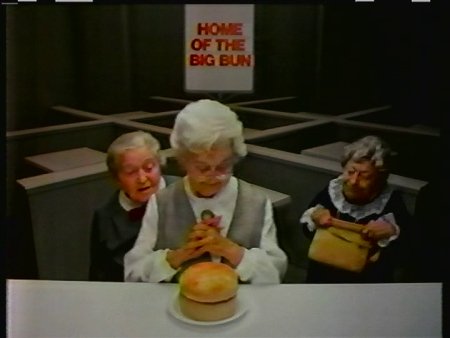
If anything matches the modern definition of a meme, it's this, which took over the country about ten years before the modern proliferation of the Internet as we know it. In early 1984 Wendy's started airing an ad where an elderly woman, played by Clara Peller, wanders into a nameless fast food joint that declares itself "HOME OF THE BIG BUN" with giant banners. Peller and her old lady friends are given a burger with a gigantic bun, but inside is a tiny beef patty. Enraged, Peller shouts at whoever sold her this thing, "WHERE'S THE BEEF?"
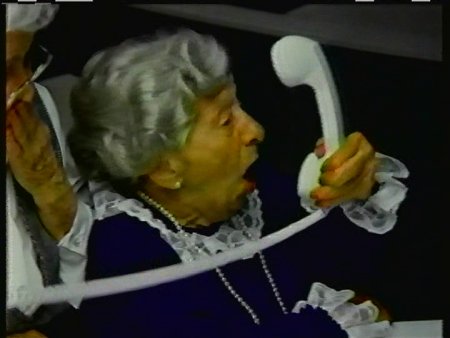
There were a lot ads airing in 1984. Why this one, and why single out this particular line? We may never know, but as I explained earlier, memes rarely ever make sense. They simply exist, they simply happen. Within weeks, "WHERE'S THE BEEF" was the only thing anybody in America could say. It wasn't even the first ad of its kind...it was preceded by an earlier ad where a middle-aged man was given the same product and said "Thanks, but where's the beef?" in a more understated way. I suppose it just needed the right delivery.
When I was transferring my dad's tapes to digital, I would do them in clumps from specific years, and I'd hear the tapes playing while I was doing other things. When I did the batch from 1984, I swear I heard that lady yelling the line every three minutes, sometimes even less. It was incessant. (Then I did 1985 and heard "We Are The World" every three minutes.)
There were not only sequel ads where Peller continued to scream the line, but a truckload of "WTB" merchandise that included stickers, frisbees, a Milton Bradley board game, and a hit single performed by Nashville DJ Coyote McCloud. Everyone was demanding to know where the beef was, including presidental candidate Walter Mondale, who expressed the question at rival candidate Gary Hart during a primary debate.
But it all only lasted a few months. "Where's The Beef" mania would flame out faster than you can say "Labubu," but the day it truly ended was sometime in 1985 when Peller appeared in an ad for Prego spaghetti sauce and declared she had FOUND the beef. Wendy's wasn't happy and never called her back in again, even though spaghetti sauce and fast food are not competing markets.
KILROY WAS HERE
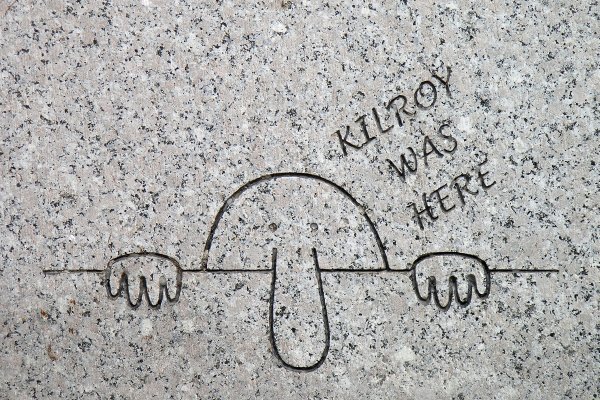
This is the ancient meme we know the least about. At some point during World War II, GIs stationed overseas started drawing a bald man's head peering out over a wall, with his nose protruding it, and the words "KILROY WAS HERE" alongside the image. They would draw this doodle on their own aircraft and equipment, but most typically, they would leave it as graffiti wherever they went.
The implication is that the bald man's name was Kilroy, but most soldiers at the time could not agree on a name. Depending on who you asked, the man's name was Chad, Mr. Chad (the two most common), Smoe, Clem, Flywheel, Private Snoops, Overby, Scabooch, Sapo, and even Eugene the Jeep, that last one being the name of an imaginary animal in the Popeye comic strip. For those wondering, the man does not resemble Eugene the Jeep at all.
We don't know who started the "Kilroy" doodle and why, but we have a good idea of why people kept doing it. Marching through enemy territory was dangerous and troops never knew if they were alone. If they saw the Kilroy doodle somewhere, they knew allies had already passed through the area. This practice is reflected in a 1948 Bugs Bunny short, Haredevil Hare, where Bugs declares himself to be "the first living thing to ever land on the moon"...as he passes a Kilroy doodle left on a rock.
After WWII, the "Kilroy" doodle lost its meaning and became a standard cliche for graffiti, or something you draw to waste time. But we'll always remember your valiant service, Mr. Chad. Or whatever your name was.
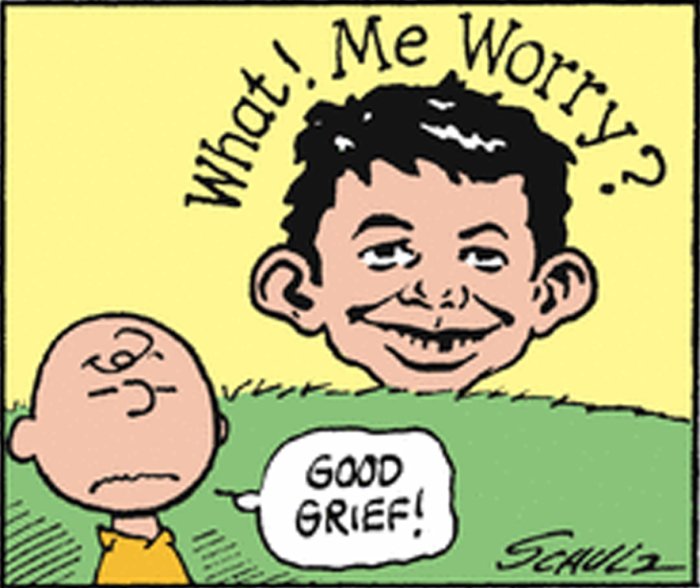
WHAT -- ME WORRY?
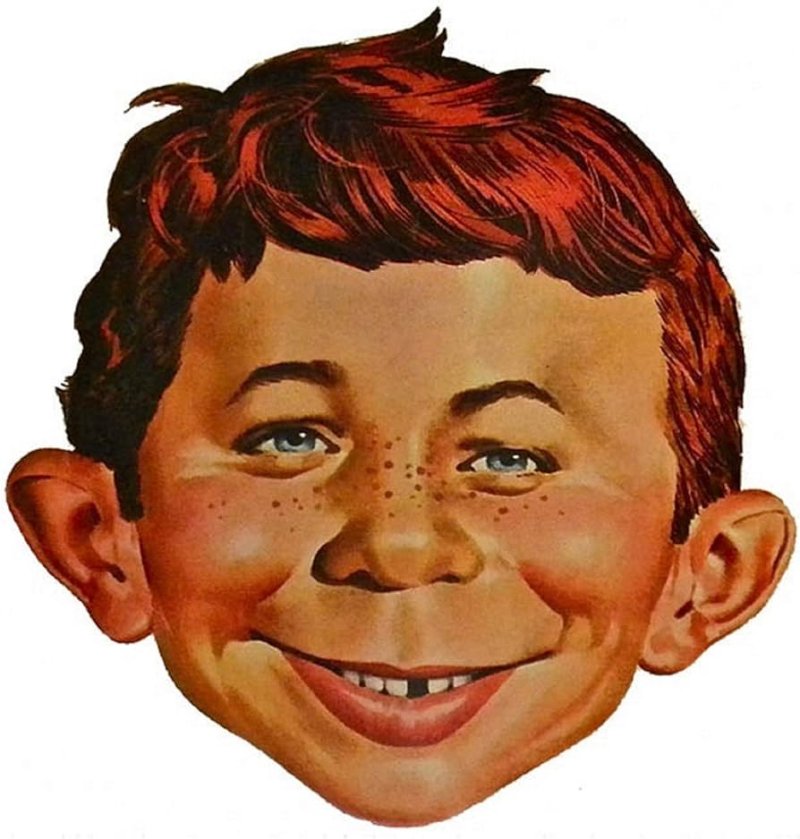
He may be a heavily trademarked image today, but believe it or not, Alfred E. Neuman and his signature catchphrase did not originate in MAD. Instead Alfred dates back much further, with his true origin being...a meme.
The face predates the name, and it goes so far back that no one knows where it truly came from. All we know is that sometime in the 19th century, drawings of a goofy-looking kid started showing up in newspapers and advertising. Depictions of the kid had variations at first, but eventually settled on these elements: a gap in the teeth, gigantic ears, uneven eye placement like Shannen Doherty's, and a dimwitted expression. The earliest known occurrence of this face appears on ads for the Broadway play The New Boy in 1894, and has the phrase "What's the good of anything? --Nothing!" printed beneath it..believed by some to be the proto-version of "What Me Worry."
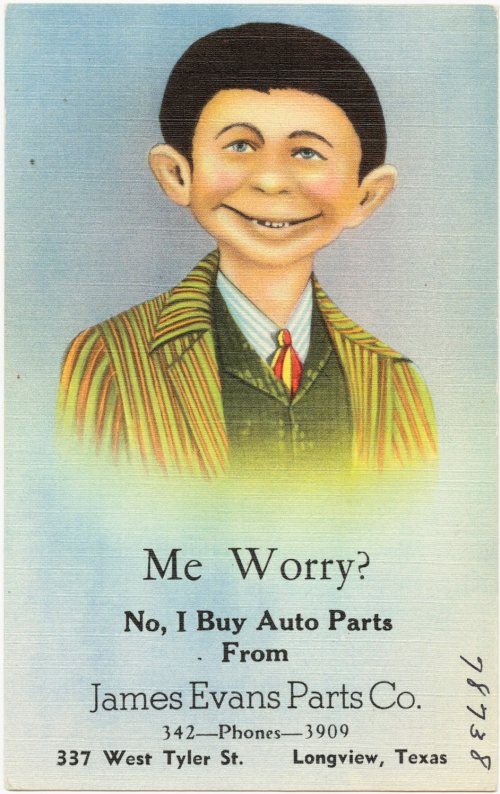
As the face kept appearing, it was often used in advertising, and eventually "Me Worry?" started appearing below it. Some used the face's absent-minded appearance to mock those they didn't care for; a political ad showed the face with the caption "Sure, I'm for Roosevelt."
By the time the first issues of MAD hit the stands in the early 1950s, the face -- which still did not have an agreed-upon name -- had been in use for over sixty years. EC editor Harvey Kurtzman spotted the face on a postcard and thought it might be a good image for the cover of The Mad Reader, the first book collection of MAD cartoons. That was in 1954; it was added to MAD covers starting with Issue 21 in 1955, and has been on almost every cover since.
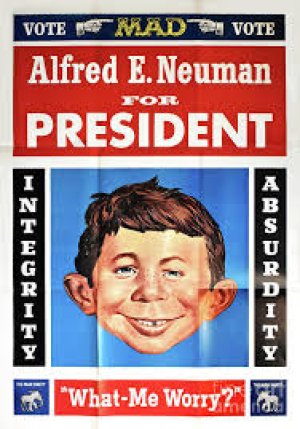
As for the name, it was a reference to the editors' favorite radio program Here's Morgan, hosted by comedian Henry Morgan. One character on that program had the name Alfred Newman, a reference in itself -- named for a famous composer at the time who scored movies (the 20th Century Studios fanfare was his own creation). MAD changed the spelling a bit to make it legal and Alfred E. Neuman was born. Yes, you read all this right -- the theme that appears before Alien and Star Wars has a thematic connection with the mascot for MAD.
But if you're going to base your mascot off a postcard, won't you run into legal problems later? That happened in a 1965 Supreme Court case between MAD's parent company and a small publisher that claimed they held a 1914 copyright on the face. MAD was easily able to provide examples of it appearing earlier than that, and the Court ruled in their favor. That being said, as an iconic mascot, Neuman today is not as "free" as he was back then.